What is a MUN?
Model United Nations, explained
New to all this? Start here. A friendly, no-jargon introduction to what Model UN actually is, how a conference plays out, and why delegates keep coming back for more.
So… what actually is a MUN?
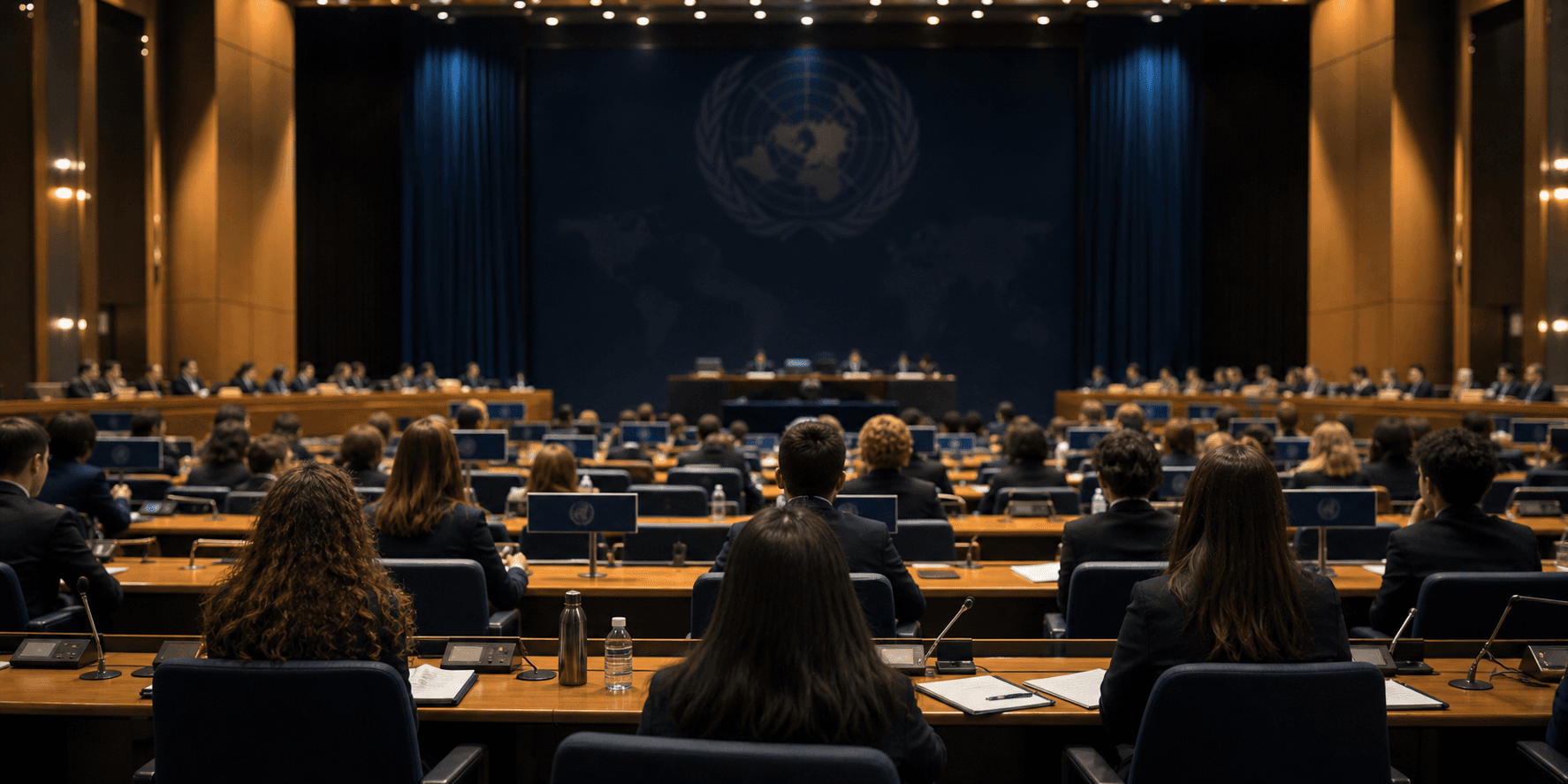
MUN stands for Model United Nations.It's an educational activity where students learn about diplomacy, international relations, and the United Nations — by actually doing it.
At a conference, you (the delegate) represent a country or organisation inside a simulation of a real UN committee. You discuss and debate global issues with everyone else in the room, and try to find solutions through diplomacy — exactly the way real UN delegates do. Conferences run anywhere from your local school hall all the way up to big international stages.
MUN at a glance
- What it is
- A simulation of UN committees where students role-play as country delegates.
- Who you are
- A “delegate” assigned to represent a specific country (not your own opinions).
- The goal
- Debate a global issue and pass a written resolution through diplomacy.
- Where it runs
- School halls, universities, and international conferences worldwide.
- What you take away
- Research, public speaking, negotiation and a serious CV booster.
Older than the UN itself
Students were simulating world diplomacy before the United Nations even existed. The first recorded conference ran at the University of Oxford in 1921 — as a Model League of Nations, since the UN wasn't founded until 1945. The idea crossed the Atlantic to Harvard in the 1920s, and through the 1940s the simulations switched from the failed League over to the new United Nations.
Today MUN is one of the largest student activities in the world, with conferences on every continent and hundreds of thousands of delegates each year.
How a MUN works, start to finish
You become a delegate
representing a country or organisation
You join a committee
a simulated UN body with one big topic
You debate the issue
speeches, questions, negotiation
You draft a resolution
a written plan to solve it
The committee votes
the best resolution passes
Types of committees
Not all committees feel the same. Bigger rooms are more formal and beginner-friendly; smaller ones move fast and reward quick thinking.
General Assembly
Large · 50–150+The biggest committees, where every member state has a seat. Broad global topics, lots of delegates, plenty of formal debate.
Economic & Social Council
Mid · 30–80Mid-sized, resolution-based committees on social, economic and environmental issues — from women's rights to pandemic response.
Security Council
Small · 15Small, fast and high-pressure. Deals with peace and security, debates clause-by-clause, and can pass binding action.
Crisis / Specialised
Small · 10–30Historical, regional or fictional cabinets where the situation changes mid-session. You react in real time with directives.
The people in the room
Delegate
You. You represent one country or character and argue its position.
The Dais / Chair
The committee staff at the front who run debate, keep time and recognise speakers.
Bloc
An informal group of delegates with shared interests who write a resolution together.
Main Submitter
The delegate who authors and formally presents a draft resolution to the room.
Admin / Runner
Volunteers who pass notes between delegates and help the dais.
How a delegate prepares
Know your country
Most delegates over-research the topic and under-research the country. Your edge is your country's actual record, allies and red lines on the issue.
Research the topic
Understand the problem, what the UN has already tried, and where the deadlock is. Skim past resolutions on it.
Write a position paper
A one-page summary of your country's stance — usually three short paragraphs: the problem, your country's position, and your proposed solutions.
Prepare an opening speech
A short, punchy statement of where you stand. It's the first impression the room gets of your delegation.
What you get out of it
Research skills
A good delegate thoroughly researches their country's position — and everyone else's too.
Communication
You have to “lobby” — sell your ideas and win other delegates over to your side.
Thinking on your feet
Issues move fast. You learn to think critically and respond in the moment.
University applications
For humanities-leaning applicants especially, MUN experience looks like gold.
Public speaking
Few activities throw you in front of a room this often. Nerves fade fast with practice.
Networking
You meet people across schools and countries — friends you may even study with one day.
Six words you'll hear on day one
MUN has its own vocabulary. Learn these and the rest of the jargon falls into place quickly.
Placard
The name card you raise to vote or to ask to speak.
Motion
A formal request to do something procedural — like start a caucus or move to a vote.
Caucus
A break from formal debate: moderated (short speeches on a sub-topic) or unmoderated (free lobbying time).
Resolution
The written document of solutions the committee debates and ultimately votes on.
Amendment
A proposed change to the wording of a draft resolution.
Quorum
The minimum number of delegates that must be present for the committee to do business.
What do committees actually debate?
Pretty much anything that matters on the world stage. A few of the classics:
Good places to learn more
We pulled this together from a few trusted guides. If you want to keep reading, these are the ones worth your time: