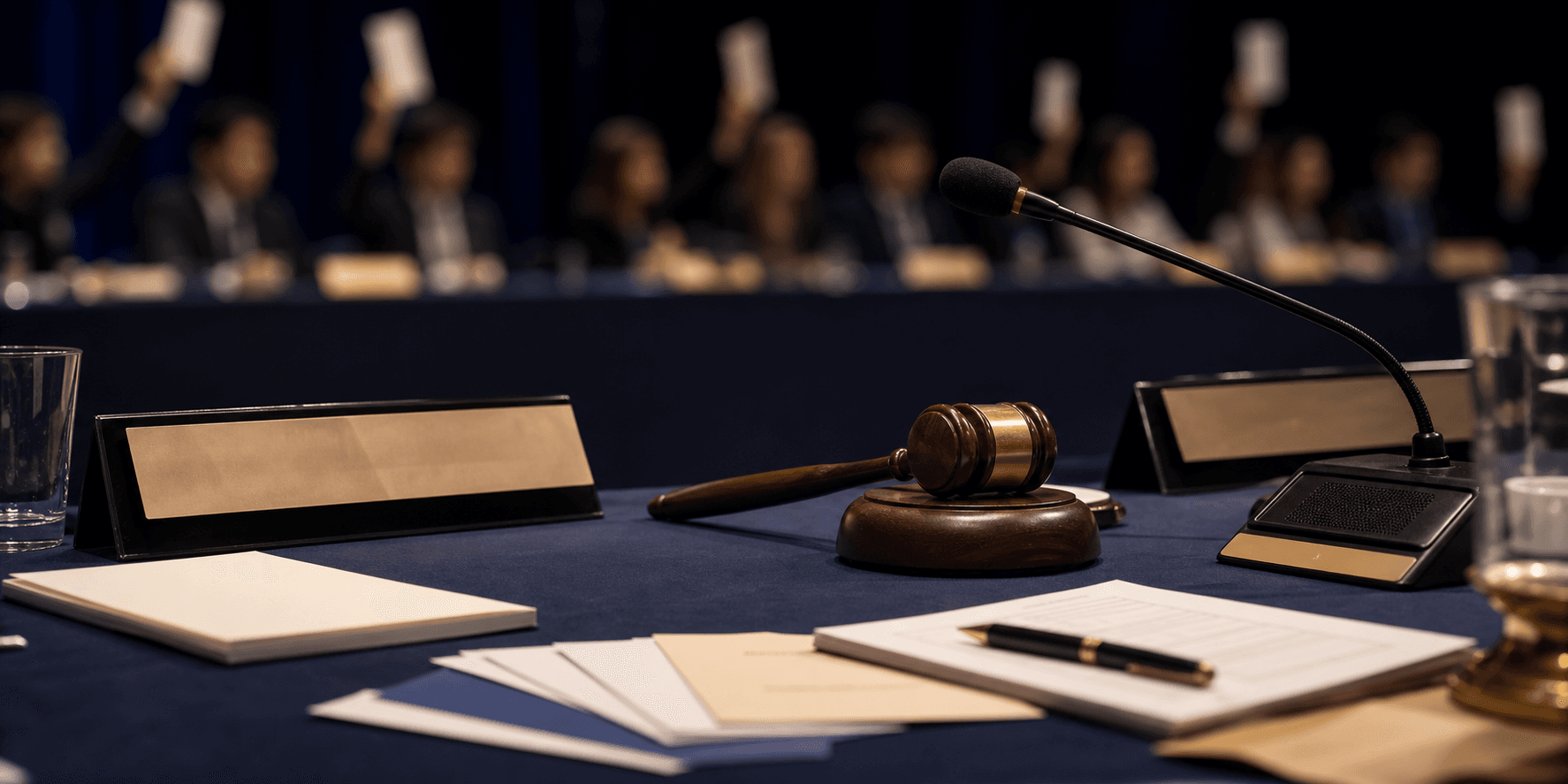
MUN Procedures
Rules of debate, motions & points
How a committee session actually runs — the way you speak, the motions that move debate forward, the points that protect you, and yes, what to wear.
How a committee session actually runs
Rules of procedure exist for one reason: to keep order so everyone gets heard. They decide who speaks, on what, and when. It can look like a lot at first, but it's really just a shared set of manners. Rules vary between conferences — each one hands out its own procedure document, so always check theirs.
The “what do I say?” cheat sheet
Ninety percent of procedure is knowing the right phrase for the moment. Here's the short list.
| If you want to… | Do / say this |
|---|---|
| You want to speak | Raise your placard and wait to be recognised by the chair. |
| You want to start an informal discussion | “Motion for a moderated caucus on … for X minutes, Y seconds each.” |
| You want free time to lobby & write | “Motion for an unmoderated caucus for X minutes.” |
| You can't hear / are uncomfortable | “Point of personal privilege.” (the only point that can interrupt a speaker) |
| You're confused about the rules | “Point of parliamentary inquiry.” |
| You think the chair made a mistake | “Point of order.” |
| You want to ask a speaker a question | Wait for them to yield to points of information, then raise your placard. |
| You think it's time to vote | “Motion to close debate and move into voting procedure.” |
Two modes of debate
Formal consultation
The structured part, run under the chair's supervision. Speeches, questions, introducing and debating resolutions — all with the rules of procedure switched on so only one delegate speaks at a time.
Informal consultation
Everything off-mic: the face-to-face talking, lobbying and deal-making that happens from the moment you walk in. No formal rules — this is where a lot of the real work gets done.
Four rules to never break
Speak in the third person
Never say “you” or “I”. Instead say “The delegate of ______”. It keeps debate formal and impersonal.
Never talk directly to each other
Delegates address one another through the chair — or pass notes. Lift a note in the air and an admin delivers it.
Raise your placard
For roll call, voting, or whenever you want to speak or ask something, raise your placard and wait for the chair to recognise you.
Only one resolution passes
In the end the committee adopts a single resolution — so make sure yours is the one worth voting for.
The flow of a session
Roll call
The chair reads out each country. Answer “present” — or “present and voting” if you intend to commit to a yes/no on every resolution (it means you can't abstain later).
Set the agenda
The committee formally adopts the topic it will debate. A simple majority sets it.
Speakers' list (formal debate)
The backbone of debate. Delegates are queued to give speeches; the default speaking time is usually around 90 seconds unless a motion changes it.
Caucusing
Debate breaks into moderated caucuses (structured mini-debates) and unmoderated caucuses (free time to lobby and write).
Draft resolutions & amendments
Delegations team up to write draft resolutions, then propose amendments — changes to the wording — to refine them.
Closure of debate
When enough drafts are on the floor, a delegate moves to close debate and push the committee into voting.
Voting procedure
Amendments are voted on first, then the resolutions themselves. Pass, and it becomes the committee's official stance.
Yielding your time
If you don't use all your speaking time in formal debate, you can yieldwhat's left in one of three ways:
To another delegate
Hand your leftover time to a delegate, who may accept or decline it.
To points of information
Open the floor to questions from other delegates about your speech.
To the chair
Simply give your remaining time back to the chair.
Motions you'll hear most
A motion is a request to do something procedural. The chair puts it to the room, and it passes if enough delegates agree.
| Motion | What it does | Majority |
|---|---|---|
| Set the speakers' list | Opens formal debate; delegates queue up to speak. | Simple |
| Moderated caucus | Structured debate on a sub-topic with a set speaker time. | Simple |
| Unmoderated caucus | Free recess to lobby, negotiate and draft — rules are suspended. | Simple |
| Introduce a draft resolution | Brings a sponsor's draft resolution onto the floor. | Simple |
| Divide the question | Vote on individual clauses separately rather than the whole. | Simple |
| Adjourn the debate | Halts work on an item — a “no-action” move that can block a draft. | Simple |
| Close the debate | Ends discussion and moves the committee to voting. | 2/3 |
| Suspend the meeting | Pauses the session — used for breaks and lunch. | Simple |
| Appeal the chair's decision | Formally challenges a ruling made by the chair. | 2/3 |
| Adjourn the session | Closes the meeting — used at the very end of the conference. | Simple |
Precedence matters. When several motions are on the table at once, the chair takes them in order of disruptiveness: suspend the meeting → adjourn the meeting → adjourn the debate → close the debate.
Friendly & unfriendly amendments
An amendment adds to, deletes from, or revises part of a draft resolution. There are two flavours:
Friendly
All the sponsors of the resolution agree to the change. Because there's no dispute, it's simply folded into the draft — no debate, no vote needed.
Unfriendly
At least one sponsor disagrees. It has to be introduced by motion, debated (typically two speakers for, two against), and then put to a committee vote to pass.
Points & rights
Where motions move debate, points protect you and keep things running smoothly.
Point of Personal Privilege
Used when you're uncomfortable — can't hear a speaker, or need the bathroom. The only point that can interrupt a speaker.
Point of Parliamentary Inquiry
A question to the chair about the rules or procedure. Cannot interrupt a speaker.
Point of Order
Raised when you believe the chair has misapplied the rules. Convention: make a “T” with your hand and placard to signal it.
Right of Reply
Used when your country or your personal integrity has been insulted and you want to formally respond.
Point of Information
The right to ask another delegate a question — only during formal debate, when they yield their time to questions.
The dress code
It changes a little from conference to conference, but the spirit is always the same: dress like a diplomat.
Do wear
- ✓Office / business attire (dress pants, button-ups)
- ✓Skirts over the knee
- ✓Dress shoes, plain boots or closed heels
- ✓A blazer or sweater (recommended, handy if it's cold)
Don't wear
- ✕Denim, shorts or casual shirts (e.g. polos)
- ✕Sneakers, open-toe heels or stilettos
- ✕Caps, hats or military wear
- ✕Deep V-necks, exposed midriff, or political slogans
How to structure a speech
Speaking time is short and precious. A simple four-beat structure keeps you clear under pressure.
Open strong
One line that frames your country's stance. Skip the “good morning honourable chair” padding if time is tight.
State the problem
Show you understand the issue and why it matters to your country specifically.
Offer a solution
Point to a concrete idea — ideally one that's already in, or could go into, a draft resolution.
Call to action
Tell the room what you want them to do: support a clause, join your bloc, back your draft.
Good places to learn more
We pulled this together from a few trusted guides. If you want to keep reading, these are the ones worth your time: